Memories: In the days of Concorde

Aviation consultant Jennifer Coutts Clay shares her memories of working onboard the supersonic jet liner
At the grand finale of the Queen’s golden jubilee celebrations in 2002, more than a million revellers packed the streets of central London, each appearing to recognise the beautiful delta wing shape of Concorde.
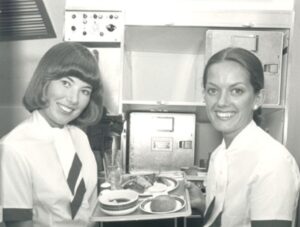
But how many of those spectators would have recognised the interior of Concorde? What did it look like? And how did it feel to live the high life 10 miles up? During the Concorde era, advertising programmes focused on the amazing exterior outline of the fuselage with the world’s only supersonic passenger airliner. The interior of this flying miracle, however, was far more conventional.
When Concorde was introduced into commercial service in 1976 passengers, commented most frequently on the lack of space in the cabin or that it was much smaller than they had expected.
As they boarded the aircraft, the first words from flight attendants were likely to be: “Mind your head, please”. The entryway door located just behind the needle nose cockpit area was smaller
than those of today‘s commercial jets, and much more like a modern 50-seat regional jet. Average size North Atlantic business travellers had to bow their heads on entering the cabin, but anyone who was larger than average might find the central aisle to be a rather tight fit.
Although there was less space in the business class cabins of supersonic transplanted aircraft, the length of time spent on board was considerably shorter. Concorde flew to New York from Paris and London in about three and a half hours. So with the five- or six-hour time difference passengers arrived before they left, hence its nickname of the ‘Time Machine’.
Passengers who were new to Concorde often asked whether it’d be an exhausting experience to fly at about twice the speed of sound, and at twice the height of Mount Everest. Regulars were quick to explain that a supersonic flight in many ways resembled a half-day trip in an ultra‑luxurious land vehicle or super yacht.
Some sales brochures explained that the Concorde cabin was stretched by approximately seven to ten inches during the flight due to the heating of the airframe, although they neglected to inform passengers that because of the stretching the bifold doors of some of the
lavatories were prone to getting stuck, particularly in the Atlantic section of the journey… Invariably, it seemed that the grandest titled names were the ones that got trapped and noisy dramas ensued.
Another Concorde conundrum was that of mysteriously shrinking carpets. Imperceptibly the carpet would inch back from the rear facing front wall and creep towards the toes of unsuspecting passengers seated in the first row of the cabin. As the bare flooring started to reveal itself,
there would be heated debates as to whether too much champagne had been imbibed. Eventually, the ground crews refined the installation procedure and established a way to stop the directional
full movement from dragging the first few inches of the carpet back to the aircraft.
The latest edition of Jennifer Coutts Clay’s book ‘Jetliner Cabins’ is now available on
Amazon, and as an Apple and Google app.