
UATP Airline Distribution: Experts pick out the limitations on airlines that are about to be overcome
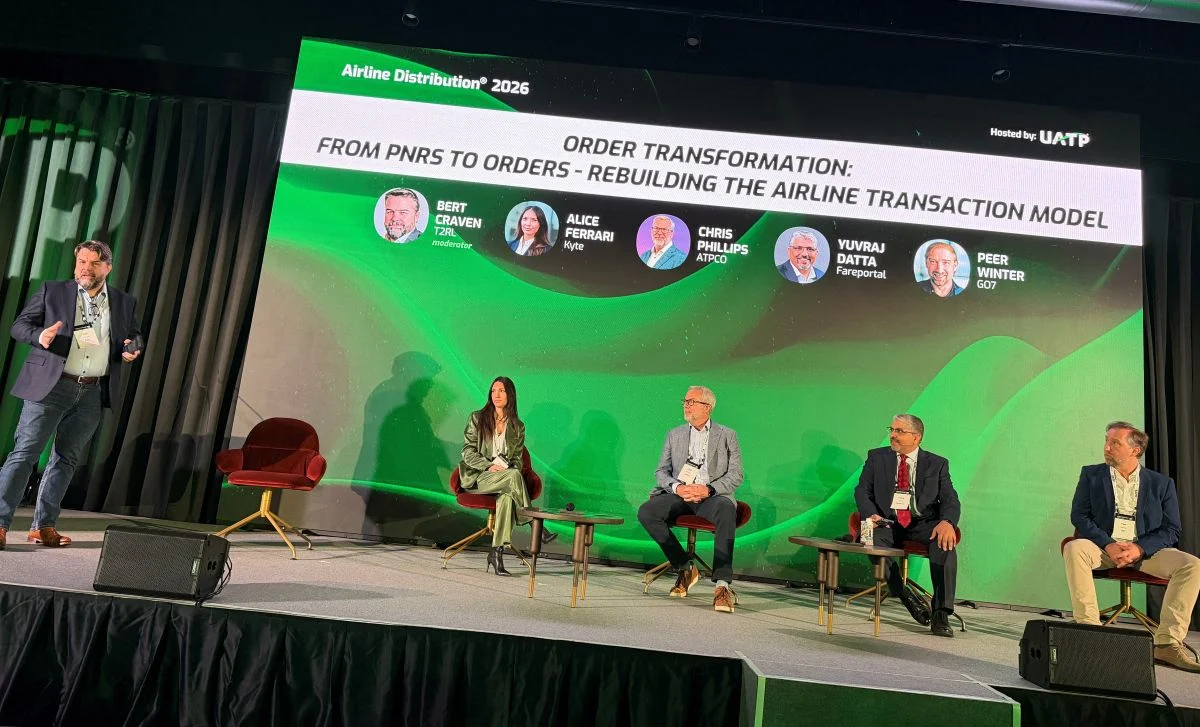
The looming transformation of airline retailing is poised to eliminate a lot of restrictions inherent in the current system, but to what extent and what barriers will be removed.
That was the question posed to an expert panel at last month’s annual UATP Airline Distribution conference in Barcelona.
Bert Craven, president technology and deputy chief executive of T2RL, which advises airlines on how to ditch legacy systems for new emerging Offer, Order Settle, Deliver, protocols, said the sector has historically undergone such transformation.
But he reminded the event that when the industry moved from paper to electronic tickets it retained the limitation they only had four different coupon types.
“We have a history of doing this, maybe not brilliantly, and we are about to make a much more significant change. The question is what are the limitations we are going to get away from.”
Alice Ferarri, chief executive of Kyte, a platform that connect airlines directly with distribution partners and specialists in the low cost sector, said:
“From our perspective because we are representing airlines get whatever they want across to third parties and the trade, certainly the limitations are time.
“Time to market is one of the most frustrating elements for any airline because commercially it’s holding them back.”
Chris Phillips, chief commercial officer of the fare filing specialist ATPCO, pointed to unnecessary costs inherent in the current system that could be eradicated.
“One of the limitations that we deal with with our partners is really around settlement – trying to link up a fare that was filed to a ticket, figuring out what the tax obligations are.
“It’s infinitely complex. It costs the industry hundreds of millions of dollars of misaligned revenue alone. This new world of orders has the potential to eliminate all of that problem.”
Fareportal’s chief supply and revenue officer, Yuvraj Datta, focussed on the customer experience that he said will be “upgraded and upscaled”.
“We as a company see not just filing issues and reconciliation issues but more important the customer experience.
“They choose a fare and they want to choose ancillaries. In travel demand we are really really stone age. Just think about how different the experience is on Amazon.”
Connectivity constraints was the issue that Peet Winter, chief distribution officer of GO7 said he wanted to address.
As well as being an aggregator and GDS connectivity provider and PSS systems, GO7 has also developed a virtual interlining platform allowing airlines not in any formal alliance to orchestrate their operations.
“The industry codeshare limitations are quite big,” he said. “Airlines have to spend a lot of money in realising codeshare potential. We want to give airlines the opportunity to decrease their costs and to take out the complexity of codeshare.”