Swarm tech takes off

In this Q&A with MRO Management, Chan Woo Jung, senior vice president and head of the maintenance and engineering division at Korean Air, explains how the airline is shifting from manual checks to AI-driven drone swarm inspections.
What problem are you solving, and how does this approach change aircraft inspections compared with traditional visual checks?
We focused on overcoming the inherent limitations of both conventional manual inspections and single-drone operations.
Firstly, traditional visual inspections are inefficient and physically demanding, requiring technicians to use aerial work platforms to manually inspect the entire exterior of an aircraft. For large aircraft such as the B747 and A380, this process can take over 10 hours which not only leads to variations in inspection quality due to human fatigue, but also exposes technicians to safety risks associated with working at height.

Secondly, the use of a single drone presents its own limitations. Flight-time constraints make it difficult to inspect large aircraft within a single session. In addition, if equipment fails, the inspection area must be reassigned, creating a significant operational burden.
Korean Air’s swarm-based operation transforms this process. By carrying out simultaneous inspections, these bottlenecks are eliminated, reducing the imaging time for a widebody aircraft to approximately 20 minutes.
Furthermore, the system incorporates swarm rovers to inspect areas that are difficult for drones to capture, such as the underbelly and engine nacelles. This ensures comprehensive coverage without any blind spots.
Korean Air is advancing drone inspections with AI-enabled UAV swarms. What benefits does this deliver in speed, defect detection and efficiency?
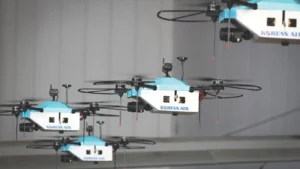
Integrating AI and swarm technologies gives us a decisive advantage across four key areas. Firstly, it delivers a significant reduction in inspection time. While a single drone typically requires around one hour to inspect a narrowbody aircraft and up to three hours for a widebody aircraft, Korean Air’s proprietary drone swarm technology dynamically adjusts the number of deployed drones according to aircraft size. This enables comprehensive external imaging and inspection to be completed in approximately 20 minutes, regardless of aircraft type.
Secondly, it achieves a new level of defect detection accuracy. During inspections, drones and rovers capture thousands of high-resolution images. Rather than relying solely on human inspection, an AI system analyses this data to identify potential defects. This significantly reduces the risk of human error and ensures highly consistent and precise detection.
Thirdly, it greatly enhances efficiency. Instead of manually reviewing every image, the system automatically flags areas of concern, allowing technicians to focus on expert analysis and decision-making rather than repetitive tasks.
Finally, it ensures uncompromising operational safety. The system operates within strictly defined boundaries using geofencing technology. If a drone deviates from its designated airspace, an automatic landing is immediately triggered.
From an MRO perspective, where is the greatest value in drone-enabled inspection?
While reduced downtime and improved data quality matter, the real value lies in enhancing and standardising safety across two key areas. Firstly, flight safety. Accurate maintenance depends on precise external inspections. Using AI to analyse large volumes of visual data removes the blind spots of manual checks, improving aircraft reliability
Secondly, occupational safety. Deploying robotic systems in elevated or hazardous environments keeps technicians out of high-risk areas, supporting strict safety standards and reducing workplace incidents. Ultimately, downtime reduction and better data are by-products of a safer, more precise inspection framework. The goal is a highly reliable environment that minimises human error while maximising safety and consistency.
How is Korean Air integrating drone inspection data into digital records, analytics and predictive maintenance systems?
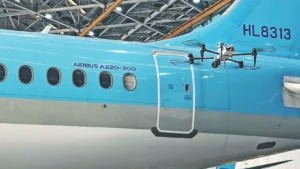
The process begins with the seamless transfer of high-resolution visual and sensor data captured by our swarm system to an AI server for initial analysis. Once a technician has completed final expert verification, confirmed findings are automatically integrated into our digital maintenance records. By transitioning away from manual logging, we ensure full transparency and traceability across all inspection results.
However, our vision extends well beyond the identification of current defects. As inspection data accumulates for each aircraft, it becomes a valuable long-term data asset. This enables us to monitor and analyse wear-and-tear patterns across specific components over time.
Ultimately, this growing data foundation will allow us to embed advanced predictive maintenance capabilities into our operations, shifting from reactive inspection towards proactive, data-driven reliability management.
How do you think drone technology will evolve in MRO?
While drones cannot yet perform direct physical repairs, rapid progress is expected in two areas: expanded operating environments and more advanced diagnostics.
Firstly, inspection environments will expand to enhance efficiency. Activities will move beyond hangars to designated ‘drone zones’ on airport ramps. By reducing the time required for visual inspections during ground turnarounds, this technology will directly support improved on-time performance – a vital metric in airline operations.
Secondly, Non-Destructive Testing (NDT) will advance significantly. Future drones and rovers will move beyond cameras, integrating tools such as ultrasonic and thermal sensors for deeper, more precise assessment of structures and engine components.
While fully autonomous robotic maintenance remains a longer-term ambition, innovation is accelerating. We expect drones and rovers to become the industry standard for aircraft diagnostics in the near future.